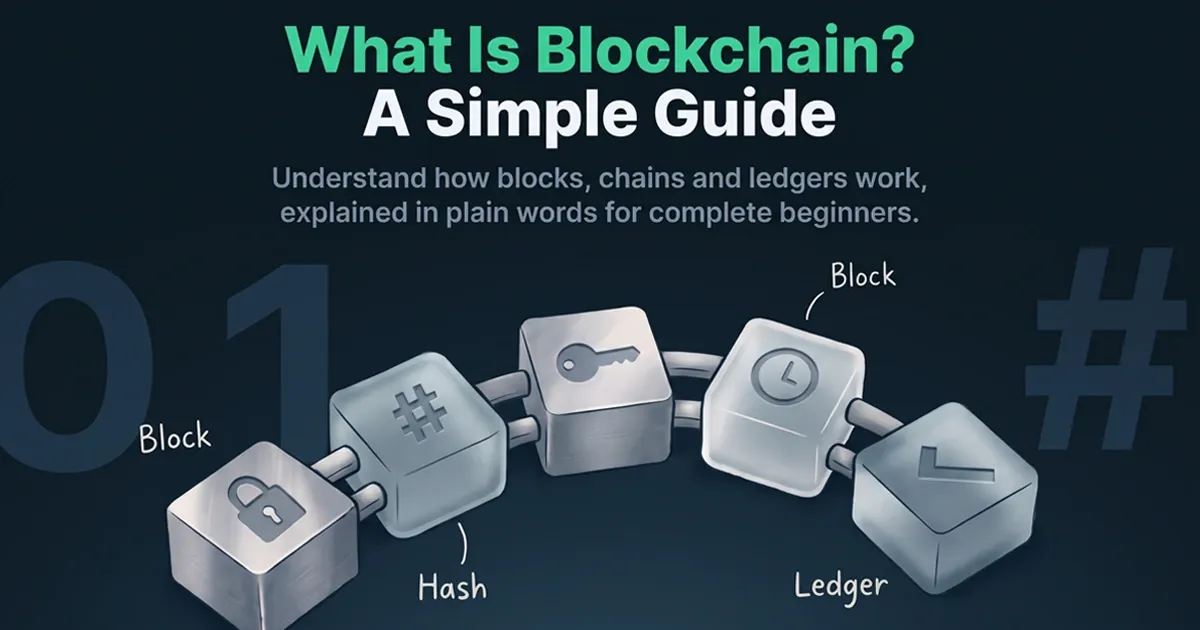
What is blockchain?
Blockchain is a shared digital record book that many computers keep in sync. Transactions are grouped into blocks, and each block is locked to the one before it with a cryptographic fingerprint called a hash. Once a block is added, it is extremely hard to change. That lets people move and record value without a bank in the middle.
If you searched "what is blockchain", you have probably heard the word next to Bitcoin, crypto or Web3 and want a straight answer without the jargon. This guide gives you one. It covers blockchain explained in plain language, how blockchain works step by step, what it is used for and where it falls short.
Disclosure first. TAAQO is our network, so we use it as the worked example in the second half. We also say where blockchain is a poor fit, because a beginner guide that only sells is not much use. Facts about Bitcoin and Ethereum come from their own public documentation, and TAAQO figures come from taaqo.com.
What is a blockchain, and what is "the blockchain"?
People type "what is a blockchain" and "what is the blockchain" as if the questions were identical. They are close, but they mean different things.
- A blockchain. Any network that stores data in linked blocks. Bitcoin, Ethereum and TAAQO are each a blockchain.
- The blockchain. Usually shorthand for the technology as a whole, or for the one chain the speaker means, which is often Bitcoin.
- Blockchain, with no article. The general idea of a shared ledger that you can add to but not quietly edit.
So when a headline says "the blockchain recorded the payment", ask which one. Different blockchains have different speeds, fees and rules, and those differences matter more than the label.
Blockchain explained with a simple analogy
Picture a notebook that exists in a thousand places at once. Every time someone sends money, a new line is written. Every copy receives the same line within seconds. Nobody owns the notebook, anyone can read it, and nobody can tear out a page without the other 999 copies disagreeing.
That is blockchain explained in one picture. The lines are transactions, the pages are blocks and the thousand places are computers called nodes. Because the copies must always match, cheating is expensive and usually obvious.
A bank works differently. It keeps one private ledger and you trust the bank to keep it right. A blockchain keeps a shared ledger, and you trust rules and maths that anyone can check.
| Bank ledger | Blockchain ledger | |
|---|---|---|
| Who keeps the record | One institution | Many independent nodes |
| Who can read it | The bank and you, privately | Anyone, on a public chain |
| Who can change it | The bank | Nobody alone, because the network must agree |
| When it runs | Often business hours for some transfers | 24 hours a day, every day |
| What you trust | The institution | Open rules and cryptography |
How does blockchain work, step by step?
Here is how blockchain works, from the moment you press send to the moment the record is permanent.
- You create a transaction. Your wallet writes a message saying send this amount from my address to that address. It signs the message with your private key, a secret only you hold. The signature proves the request is yours without revealing the key.
- The transaction is broadcast. Your wallet passes it to a node, which passes it on until most of the network has seen it. Waiting transactions sit in a pool.
- Nodes check it. Each node tests that the signature is valid and that you have enough balance. Invalid transactions are dropped.
- A block is built. A validator, called a miner on some networks, bundles a set of valid transactions into a block.
- The network agrees. Validators follow a consensus mechanism, which is a set of rules for deciding which block comes next. Bitcoin uses proof of work. Ethereum has used proof of stake since September 2022. Both make cheating costly and checking cheap.
- The block is chained. The new block stores the hash of the previous block. A hash is a fixed-length fingerprint created by maths from data. Change one character in the data and the fingerprint changes completely.
- Everyone updates. Every node adds the block to its copy. Your transfer is now part of the shared record.
Speed depends on the network. Bitcoin adds a block about every 10 minutes. Ethereum adds one roughly every 12 seconds. TAAQO lists a block time of about 5 seconds, so a typical transfer is recorded within a few seconds.
What are the main parts of a blockchain?
Most blockchain explainers throw eight terms at you at once. This table gives each one a plain job.
| Part | What it is | Plain-English job |
|---|---|---|
| Block | A bundle of transactions, a timestamp and the previous block's hash | One page in the shared notebook |
| Hash | A fixed-length digital fingerprint of data | The seal that links pages together |
| Node | A computer that stores a copy and checks the rules | One of the many copies |
| Validator | A node that proposes and confirms new blocks | The one who writes the next page |
| Consensus | The rules for agreeing which block is next | The vote everyone accepts |
| Wallet and keys | Software that holds your private key and shows your public address | Your account and your signature |
| Smart contract | Code stored on the chain that runs when set conditions are met | A vending machine for agreements |
| Explorer | A website for looking up blocks and transactions | A search engine for the ledger |
Why is blockchain hard to hack or change?
Two things protect the record. The first is the chain of hashes. If someone edits an old transaction, the hash of its block changes, which breaks the link to every block after it. The attacker would have to redo all of those blocks.
The second is the number of copies. Even a rewritten chain is useless unless most of the network accepts it. On large networks that takes enormous money or computing power, which is why attacks on the biggest chains are rare.
Hard is not the same as impossible. Smaller chains, cross-chain bridges, buggy smart contracts and phishing links have all caused real losses. The ledger is rarely the weak point. The apps built on it, and the habits of the people using them, usually are.
What types of blockchain are there?
| Type | Who can join | Typical use |
|---|---|---|
| Public | Anyone with an internet connection | Open payments, apps and tokens. Bitcoin, Ethereum and TAAQO are public |
| Private | Only people the owner approves | Internal company records |
| Consortium | A group of organizations that share control | Shared data across one industry |
Most beginners meet public blockchains first, because that is where wallets, tokens and apps live.
What is a Layer 2 blockchain?
A Layer 1 is a base network such as Bitcoin or Ethereum mainnet. It handles security and final settlement. When many people use it at once, fees rise and transfers slow down.
A Layer 2 is a network built on top that processes transactions faster and cheaper. Ethereum's own documentation treats Layer 2 networks as a central part of how it scales. EVM-compatible means the network runs the same smart contract language and tools as Ethereum, so developers can reuse Solidity code and users can keep wallets like MetaMask.
TAAQO describes itself as an EVM-compatible Layer 2 blockchain. Its whitepaper explains the design in detail, and its features page lists what is live today.
What is blockchain used for? Blockchain for beginners
Blockchain for beginners usually starts with crypto, but the uses go further.
- Payments and transfers. Send value to anyone with a wallet, at any hour, without a bank in between.
- Stablecoins. Tokens such as USDT that track a currency like the US dollar, used for payments and savings.
- Decentralized finance. Lending, swapping and earning through smart contracts instead of a broker.
- Digital ownership. NFTs and in-game items whose owner anyone can verify.
- Supply chain records. A shared log of where goods have been, with entries that are hard to alter later.
- Tokenization. Representing real-world assets such as property or funds as tokens that can move on a chain.
- Identity. Credentials that you hold yourself and can prove without handing over a full document.
What does blockchain look like on TAAQO?
Theory is easier to follow with a live network in front of you. TAAQO is a public chain, so you can inspect every block yourself. Here are the core numbers from the TAAQO site.
| Detail | TAAQO value | Copy |
|---|---|---|
| Network type | EVM-compatible Layer 2 blockchain | |
| Chain ID | 5566 | |
| Currency symbol | TAAQO | |
| Block time | About 5 seconds | |
| Listed gas fee range | $0.000000002 to $0.00000001 | |
| Listed throughput and finality | 1,500+ transactions per second, 5 to 7 seconds | |
| Public RPC endpoint | https://rpc.taaqo.com | |
| Block explorer | https://taaqoscan.com |
These figures are the ones listed on taaqo.com at the time of writing. Real fees and speeds move with network conditions, so check the site before you rely on them.
You can see every step from the section above on a real chain in about five minutes.
- Add the network. Use the Chain ID and RPC from the table, or follow the Get Started guide to add it in one click.
- Get test tokens. Claim a small amount from the Taaqo faucet, so you can practise without risking money.
- Send a small transfer. Move a tiny amount to a second address you own. This is your transaction from step one.
- Find it in the explorer. Paste the transaction hash into Taaqo Scan. You will see the block number, the block's own hash and the time it was recorded.
- Try the bridge. When you are comfortable, the USDT bridge moves stablecoins onto the network.
Developers can go further with the Developer Portal, which covers Solidity, Hardhat and Remix. Teams that want to accept or build on the network can start from the Business page, and individuals will find wallet and token steps on the Individuals page.
What are the limits and risks of blockchain?
- Transfers are final. Send funds to a wrong address and nobody can reverse it. Double-check before you confirm.
- Scams are common. Fake tokens, fake support staff and phishing links target beginners first.
- Prices swing. Coins can gain or lose a large share of their value in days. Stablecoins reduce this but carry their own risks.
- The experience can be clumsy. Wallets, networks and gas fees confuse new users, and mistakes cost money.
- Rules differ by country. Tax and legal treatment of crypto vary widely, so check your local requirements.
- Energy use depends on design. Proof of work uses a lot of electricity. Proof of stake uses far less.
None of this means blockchain is bad. It means you should learn on a test network first and treat real money with care.
How can a beginner stay safe with blockchain?
- Write your seed phrase on paper, keep it offline and never type it into a website or share it with support staff.
- Start on a test network or with an amount you can afford to lose.
- Copy addresses from a trusted source and compare the first and last characters before sending.
- Check a token's contract address in an explorer before you buy or import it.
- Ignore any message that promises guaranteed returns or asks you to connect your wallet urgently.
What are common blockchain myths?
- "Blockchain is Bitcoin." Bitcoin was the first big blockchain. Thousands of networks use the same idea now.
- "Blockchain is anonymous." Public chains are pseudonymous. Every transaction is visible, and an address can often be linked to a person.
- "Blockchain can't be hacked." The ledger is hard to rewrite, but wallets, apps and bridges get attacked all the time.
- "Blockchain only matters for crypto." Payments, records, ownership and identity systems all use it.
Frequently asked questions about what is blockchain
What is blockchain in simple words?
Blockchain is a shared digital record book kept by many computers at once. Transactions are grouped into blocks and linked together with cryptographic fingerprints, so a record is very hard to change after it is added. It lets people send value and store data without a bank or central owner.
What is the difference between a blockchain and the blockchain?
A blockchain is any network that stores data in linked blocks, such as Bitcoin, Ethereum or TAAQO. The blockchain usually means the technology in general, or the one chain a speaker has in mind, often Bitcoin. When you read the phrase, check which network is meant.
How does blockchain work?
A wallet signs a transaction and sends it to the network. Nodes check it, a validator bundles valid transactions into a block, and the network agrees on that block. The block stores the hash of the one before it, so every node adds it to the chain and the record becomes permanent.
Is blockchain the same as Bitcoin?
No. Bitcoin is one blockchain and its coin, launched in 2009. Blockchain is the underlying design, and thousands of networks use it for payments, apps, tokens and records. Ethereum, Polygon and TAAQO are other examples.
Is blockchain safe?
The ledger itself is very hard to alter because of linked hashes and many copies. Losses usually come from stolen keys, phishing, scam tokens and buggy apps built on top. Keep your seed phrase offline, check addresses twice and start with small amounts.
Who controls a blockchain?
On a public blockchain no single company controls the record. Nodes and validators follow shared rules, and changes to those rules need broad agreement. Private blockchains differ, because one organization or a small group runs them.
What is blockchain used for besides crypto?
People use blockchain for cross-border payments, stablecoins, decentralized finance, digital ownership, supply chain tracking, identity and tokenized real-world assets. Any process that needs a shared, tamper-evident record between parties who do not fully trust each other is a candidate.
What is a Layer 2 blockchain?
A Layer 2 is a network built on top of a base blockchain. It processes transactions faster and at lower cost than the base layer. An EVM-compatible Layer 2 such as TAAQO also runs the same smart contracts and uses the same wallets and tools as Ethereum.
How can I try TAAQO as a beginner?
Add the TAAQO network to your wallet with Chain ID 5566 and the RPC https://rpc.taaqo.com, claim test tokens from the faucet and send a small transfer. Then look the transaction up in Taaqo Scan to see its block number and hash.
Final thoughts
Blockchain is a shared record that many computers keep in agreement, protected by linked hashes and open rules. Once you can say what a block, a node and a hash do, most headlines about it start to make sense.
The fastest way to learn is to use one. Add the TAAQO network to your wallet, claim test tokens from the faucet and watch your own transaction appear in Taaqo Scan. This article is for information only and is not financial advice, so confirm current network details on taaqo.com before you act.