How do you buy crypto?
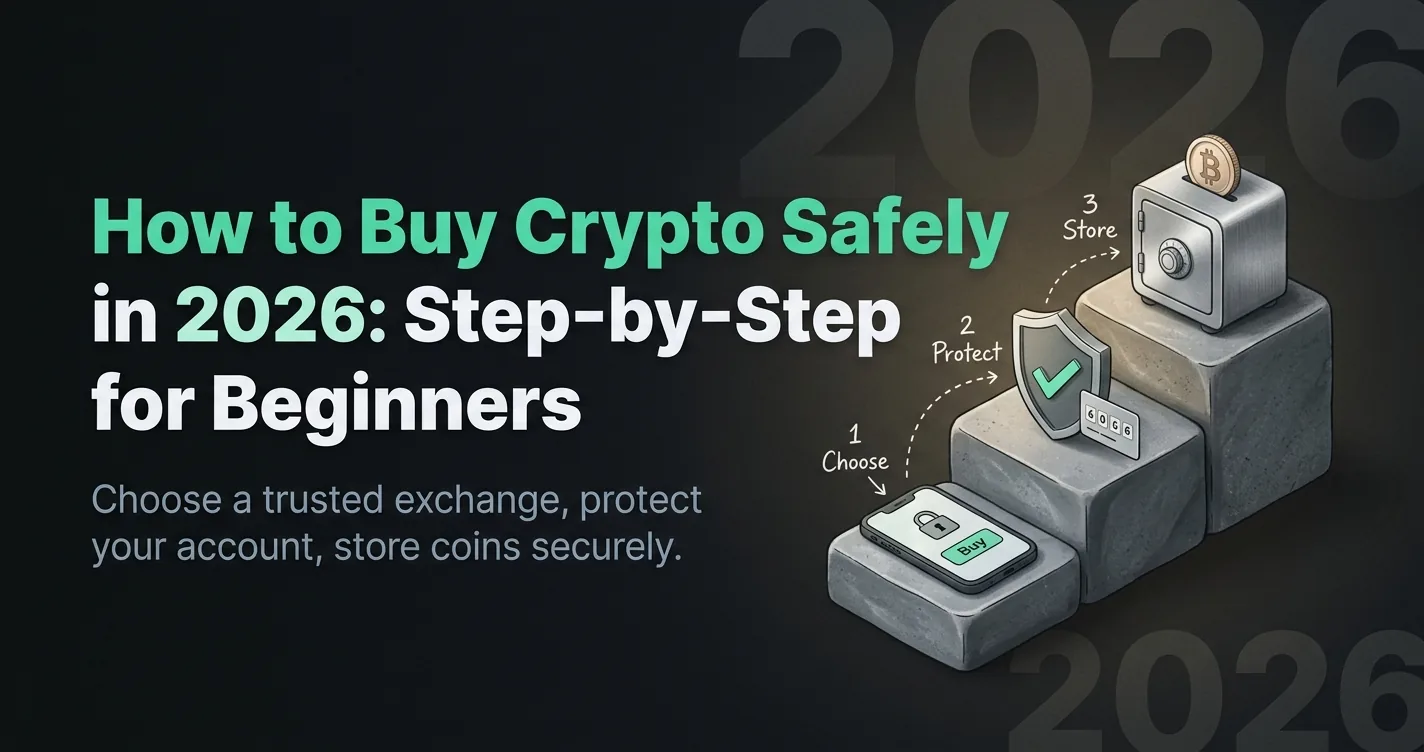
To buy crypto, choose an exchange that is registered in your country, create an account, switch on 2FA or a passkey, verify your identity, add a small amount from your bank and place a buy order. Then decide whether to keep the coins on the exchange or move them to a crypto wallet you control.
That's how to buy crypto in one breath. Doing it safely is where most of the work is. Most of what goes wrong for new buyers isn't the price. It's fake apps, "guaranteed return" groups, weak passwords and coins sent to the wrong place. This guide covers each step and the checks that protect you, wherever you live.
If words like "blockchain" and "wallet" still feel fuzzy, spend ten minutes on our beginner's guide to blockchain first. Everything below will make more sense.
What you need before you buy
Getting these ready first is the easiest way to buy crypto safely. Each one takes a few minutes and closes a door scammers like to use.
- An ID document. Registered exchanges have to verify who you are, usually with a passport, national ID card or driving licence.
- A bank account in your own name. Deposits from someone else's account are a common reason exchanges freeze or reject a transfer.
- A separate email address. Use one for money apps only, with a strong unique password.
- An authenticator app or passkey. SMS codes are better than nothing, but SIM-swap fraud is real.
- A budget you can lose. Crypto prices can fall hard. Bitcoin dropped about 47% from its October 2025 high within four months. Start with money you won't need for rent, bills or an emergency.
Step 1: Pick a registered exchange
An exchange is where you swap your dollars, euros, dirhams or any other currency for crypto. Picking the right one matters more than picking the right coin, because a bad exchange can lose everything you buy on it.
Start with registration. Most countries require crypto exchanges to register with, or get a licence from, a financial regulator, usually under anti-money-laundering rules. In the European Union that means authorisation under the MiCA regulation. In the UK it means registration with the Financial Conduct Authority. Many regulators publish a public register, so search it for the exchange's name before you sign up. If an exchange won't say where it's licensed, think twice.
Then compare the practical things:
| What to check | Why it matters |
|---|---|
| Registration status | Registered exchanges follow KYC and reporting rules, and you have somewhere to complain if things go wrong. |
| Deposit methods | Bank transfer is usually cheapest. Check what works with your bank before you sign up. |
| Fees | Look at trading fees, the spread on instant buys, and withdrawal fees for each network. |
| Withdrawals to your own wallet | You should be able to move coins out. If an exchange makes that hard, think twice. |
| Tax records | Some exchanges give you a yearly tax report or deduct tax where local law requires it. With others, the record-keeping falls on you. |
| Security features | Passkeys, an address whitelist and withdrawal locks protect you if your password leaks. |
Download the app only from the official app store link on the exchange's own website. Search ads and lookalike apps are a favourite trick for stealing logins.
Step 2: Create your account and lock it down
Sign up with your money-only email and a password you've never used anywhere else. Then, before you deposit anything, turn on the strongest login protection the exchange offers. A passkey is best where available, then an authenticator app. Also switch on the anti-phishing code if the exchange has one. It puts a secret word in every genuine email, so fakes stand out.
Two settings people skip and later regret: the withdrawal address whitelist and new-device alerts. With a whitelist on, your coins can only go to addresses you've approved, which makes a stolen password far less damaging.
Step 3: Verify your identity (KYC)
KYC stands for "know your customer". The exchange asks for a government ID, such as a passport, national ID card or driving licence, plus a live selfie. Some also ask for proof of address or check your bank account. The exact documents depend on your country. It usually takes minutes, sometimes a day or two.
Only upload documents inside the official app or website. No real exchange asks you to send ID photos over WhatsApp, Telegram or email.
Step 4: Add money
Deposit from a bank account in your own name, using a method the exchange lists in its deposit section. Start small. Your first deposit is a test of the whole route, not an investment decision.
Be careful with peer-to-peer (P2P) trading, where you pay a stranger directly and they release crypto to you. It can work, but if the other person's money turns out to come from fraud, your bank account can get pulled into the investigation. For a first purchase, a direct bank deposit is the calmer option.
Step 5: Place your first order
Most apps give you two ways to buy. The "instant buy" or "convert" button is simple, but the price often includes a wider spread, so you may pay more than the trading fee suggests. A regular market or limit order on the trading screen is usually cheaper once you're comfortable.
- Market order. Buys right away at the best available price.
- Limit order. Buys only at the price you set or better. It may not fill if the price never gets there.
Before you confirm, read the order summary line by line: the amount of crypto you'll get, the price, the fee and any tax the exchange deducts. Then check your order history to make sure it matches. Save a copy. You'll want it at tax time.
How to buy crypto: the whole process at a glance
- Pick a registered exchange. Choose an exchange that is registered or licensed with the financial regulator where you live.
- Create and lock down your account. Sign up with an email you only use for money apps, then switch on a passkey or an authenticator app before you deposit anything.
- Complete identity verification. Upload a government ID, such as a passport or national ID card, and take a live selfie when the exchange asks.
- Add money. Deposit a small amount from your own bank account using a method the exchange lists, such as a bank transfer.
- Place a small first order. Search for the coin, enter an amount in your currency and review the fees, the price and the tax line before you confirm.
- Check the order in your history. Open your order history and confirm the amount, price, fee and any tax deducted. Keep a copy for tax time.
- Decide where to keep it. Leave a trading balance on the exchange if you need it, and move the rest to a crypto wallet you control, starting with a small test withdrawal.
Bitcoin or a stablecoin: what should you buy first?
People usually ask which crypto to buy before they ask what each one is for. The second question is more useful.
| Bitcoin | Stablecoin (e.g. USDT) | |
|---|---|---|
| Price | Moves a lot, both ways | Aims to stay near $1 |
| Why people buy it | Long-term holding, a bet on future value | Payments, transfers, holding dollars |
| Main risk | Big price drops | Issuer and reserve risk, wrong-network mistakes |
| Good first lesson in | Price swings and patience | How wallets, networks and transfers work |
If you want to buy bitcoin, go in knowing that a 20% fall in a few weeks is normal for it. If your goal is to move money or learn how crypto transfers work, a stablecoin is a gentler start. Our guide on what a stablecoin is explains how coins like USDT keep their $1 value and where they can fail.
How to judge any crypto to buy
We won't tell you which coin to pick. Nobody honest can promise which one will go up. We can tell you what to check before any purchase:
- What is it for? If you can't explain its use in one sentence, wait.
- How old is it? Coins that have lasted through several market crashes have at least been tested.
- Where is it listed? A coin found only on one small exchange is much riskier.
- Who controls the supply? Check how many coins exist, how many are coming, and whether a small group holds most of them.
- Who is pushing it? Influencer hype, countdown timers and "guaranteed" returns are warning signs, not reasons to buy.
Where should you keep crypto after you buy it?
You have two choices, and many people use both.
- On the exchange. Easy to trade and sell. But the exchange holds the coins, and it can pause withdrawals or freeze an account.
- In your own crypto wallet. Only your seed phrase can move the funds. Nobody can freeze it, but nobody can recover it if you lose the phrase.
A sensible split for beginners is to keep a small trading balance on the exchange and move the rest to a wallet once you know what you're doing. When you're ready, our step-by-step guide shows how to move your USDT to your own wallet on the BEP20 network without picking the wrong network.
Want to practise first? Add the TAAQO network to a wallet from the network settings page and grab free test tokens from the faucet. Sending test tokens back and forth costs you nothing and teaches the same steps you'll use with real money. You can check every test transfer on TAAQO Scan.
Mistakes and scams to avoid
| Trap | How it works | How to avoid it |
|---|---|---|
| Fake exchange apps | A lookalike app or website steals your login or deposits | Install only from the link on the exchange's official site |
| "Guaranteed return" groups | A Telegram or WhatsApp group promises daily profit, then disappears with deposits | Real investments never guarantee returns. Leave the group |
| Romance or friendship scams | A new online contact slowly persuades you to "invest" on their platform | Never send money to a platform someone you met online recommends |
| Fake support agents | Someone posing as support asks for your seed phrase or a remote-access app | Use support only inside the official app. Nobody needs your seed phrase |
| Buying on hype | Prices spike on social media buzz, then crash | Use the five checks above before every purchase |
| Wrong network on withdrawal | Coins go to a network your wallet doesn't use | Match the network on both sides and send a test first |
Crypto tax: what to know before you buy
Most countries tax crypto in some way, but the rules vary a lot. Many treat selling, swapping or spending crypto as a taxable event, so even trading one coin for another can count. Some tax gains as capital gains, some at a flat rate, and a few don't tax them at all.
Some countries also make exchanges deduct tax at the source or report your trades straight to the tax office. Others leave the reporting entirely to you, and penalties for getting it wrong can be steep.
In practice that means keeping your order history, deposit records and transaction IDs from day one, wherever you live. We're not tax advisers, and this isn't tax advice. Check your local rules or talk to a tax professional before you file.
Frequently asked questions
How do I buy crypto for the first time?
Pick an exchange registered in your country, create an account, switch on 2FA or a passkey, complete identity checks, add a small amount from your bank and place a buy order. Start small, check the fees, and keep a record of every trade.
What is the safest way to buy crypto?
Use a registered exchange's official app or website, protect the account with a passkey or authenticator app, buy small amounts at first, and never act on tips from strangers. Move long-term holdings to a crypto wallet you control and keep the seed phrase offline.
How much money do I need to start?
Most exchanges let you start with a small amount, often just a few dollars or the same in your local currency. The exchange shows its minimum order. Only put in money you could lose without it hurting your rent, bills or savings.
Should I buy bitcoin or a stablecoin first?
They do different jobs. Bitcoin's price moves a lot, up and down. A stablecoin such as USDT aims to stay near $1, so it suits payments and transfers. Many beginners start with a stablecoin to learn how sending and wallets work.
How do I choose which crypto to buy?
Check what the coin is used for, how long it has existed, which major exchanges list it, how its supply works and who controls it. Be wary of coins pushed by influencers or promising guaranteed returns. No checklist removes the risk of loss.
Do I need a crypto wallet to buy crypto?
No. The exchange holds your coins after you buy. You need your own crypto wallet only when you want full control, want to use apps, or plan to hold for a long time. If you set one up, write the seed phrase on paper.
Is buying crypto legal?
In most countries, yes, but the rules differ. Many require exchanges to be registered or licensed, a few restrict or ban crypto trading, and most tax the gains. Check what your country's financial regulator says before you buy.
What fees will I pay when I buy crypto?
Expect a trading fee, a spread between the buy and sell price, possible deposit or withdrawal fees and, in some countries, tax deducted by the exchange. Instant buy buttons are often more expensive than a regular order. The order screen shows the total before you confirm.
Final thoughts
Learning how to buy crypto takes an afternoon. Learning to buy crypto safely is a habit. Use a registered exchange, lock the account before you deposit, start with a small amount, read every order summary, and keep records for tax. Treat anyone promising easy profit as a scammer until proven otherwise.
Once you've made your first purchase, the next skill is moving it safely. Practise with free test tokens on the TAAQO faucet, then follow our wallet guide when you're ready for real funds. This article is for information only and isn't financial, investment or tax advice. Exchanges named here are third parties with no connection to TAAQO. Crypto carries risk, including the loss of everything you put in.